


Apartment search is evolving.
While traditional search engines still play a major role in renter discovery, AI platforms like ChatGPT, Gemini, and Google’s AI Overview are increasingly becoming how prospects find, compare, and evaluate properties.
Instead of scrolling through listings, renters are asking AI direct, high-intent questions:
- “What are the best 2-bedroom apartments near the Medical Center?”
- “Pet-friendly apartments under $1,700 near US-288.”
- “Luxury apartments in Humble with golf course views.”
The question for operators isn’t whether AI traffic is large yet.
It’s whether your property is structured to be recommended when those questions are asked.
AI-Driven Apartment Search is Early But High-Intent
Industry data shows that visitors arriving from AI platforms tend to:
- Spend more time on site
- Show higher engagement
- Convert at stronger rates than traditional organic traffic
While AI-driven sessions still represent a small share of total traffic, the renters arriving this way are often further along in the decision process. They’ve asked AI specific questions, been provided a condensed list, and are comparing options.
This makes AI visibility less about awareness — and more about recommendation.
Testing AI Visibility for Multifamily
To understand how properties are performing in generative search environments (aka GEO), we conducted AI visibility testing across four apartment communities in similar markets that have been utilizing our Search360 service.
We evaluated performance in ChatGPT and Gemini.
Using 10 high-intent, non-branded renter-style queries per property such as the ones shown above.
These weren’t name searches.
They were real discovery questions tied to neighborhood, commute, amenities, and lifestyle fit.
AI Recommendation Performance
ChatGPT
- Recommended properties an average of 6 out of 10 times
- Average placement: approximately position #2
- Frequently cited the property’s own website as the source
Gemini
- Recommended properties an average of 7 out of 10 times
- Average placement: approximately position #2
- Regularly sourced the property website directly
This is not passive indexing.
It is inclusion in decision-stage recommendations.
The Impact of Structured Local Content
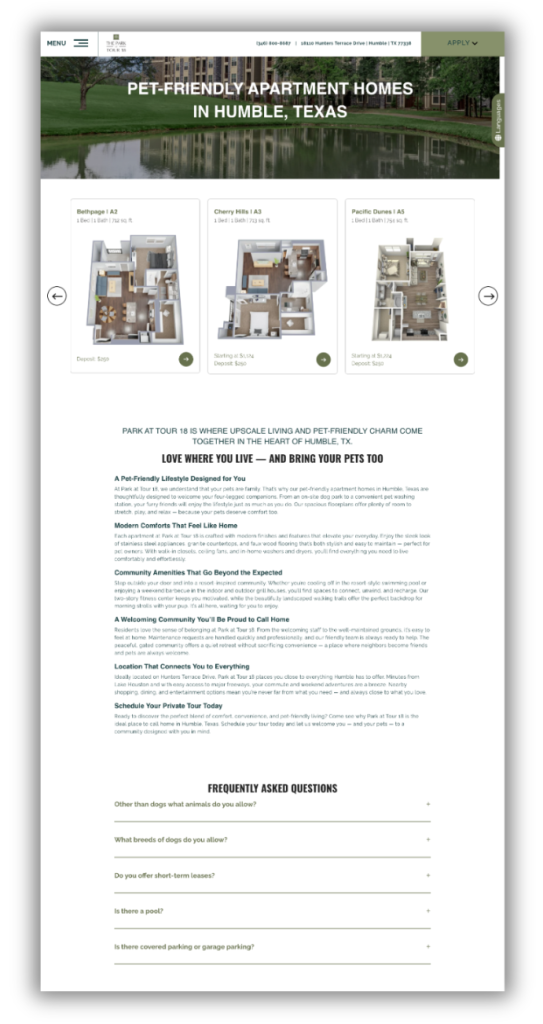
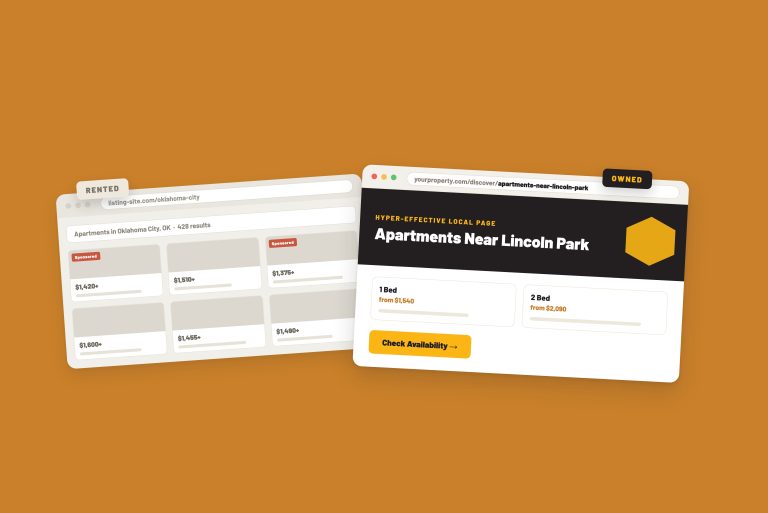
As a part of Search360, Hyper-Effective Local Pages (H.E.L.P.) are the structured content layer designed specifically to expand a property’s searchable footprint across traditional and AI-driven discovery.
H.E.L.P. pages are not blog posts.
They are intentionally built around high-intent, location-based renter queries — the exact types of questions AI systems evaluate when generating recommendations.
Across the four properties tested:
- Eligible search reach expanded from an average of 237 queries to 931 queries
- That represents a 371% average increase in searchable surface area
- Structured page count increased by an average of 222%
Expanding structured, location-specific content dramatically increases the number of renter-style queries a property becomes eligible for.
When renters ask conversational questions, AI systems rely on:
- FAQ depth
- Clear neighborhood references
- Point-of-interest proximity
- Amenity specificity
- Consistent formatting
Content architecture directly influences AI eligibility and that’s what H.E.L.P. was designed for.
Why Some Properties Get Surfaced in AI Search (And Others Don’t)
AI platforms do not “rank” properties the same way traditional search engines do.
They evaluate:
- How clearly your website explains who you are
- Whether your content actually answers renter questions
- The overall tone and consistency of your reviews
- How accurate your local information is
- Whether your property appears trustworthy across the web
AI systems can only recommend what they can clearly interpret.
The Ceiling for AI Visibility: Reviews
Of all the variables tested, review strength emerged as the most consistent differentiator.
When AI tools were prompted to explain why certain properties were not surfaced, the reasoning most often pointed to review patterns:
- Concentrated negative sentiment
- Low review amount
- Comments within reviews did not align with the renter’s criteria
AI platforms do not read a single reputation score.
They analyze:
- Sentiment consistency
- Recency
- Keyword themes
- Response engagement
- Cross-platform alignment
Properties with strong, consistent review profiles were surfaced more frequently in AI-generated recommendations.
Properties with mixed or inconsistent sentiment showed visible limitations — even when SEO execution was technically sound.
What AI Search Optimization Really Requires
To improve visibility in generative search environments, properties must focus on:
1. Structured, Location-Rich Content: Hyper-local landing pages aligned to real renter queries.
2. FAQ Expansion: Clear answers to comparison-based and lifestyle-based questions.
3. Google Business Profile Optimization: Accurate, consistent, and active local signals.
4. Review Health and Theme Alignment: Consistent sentiment and keyword-rich responses.
5. Citation and Authority Control: Ensuring AI platforms reference owned channels.
This is not a single tactic, it’s a coordinated system.
Search360 was built to unify these layers — traditional SEO, Hyper-Effective Local Pages (H.E.L.P.), Google Business Profile optimization, review alignment, and structured FAQ content — into one cohesive visibility strategy.
AI search does not require an entirely new playbook.
It requires a stronger foundation.
If you’re curious how your property performs in AI search today and what’s limiting your visibility — book a demo with our team. We’ll walk you through a visibility assessment and show you exactly where you stand.
Frequently Asked Questions About AI and Apartment Search
Does AI replace traditional search for apartments?
No. AI layers on top of traditional search. It synthesizes information from websites, reviews, and local signals to generate recommended options.
How do AI tools decide which apartments to recommend?
AI platforms evaluate structured content, review patterns, local relevance, and trust signals across multiple sources.
Do star ratings alone determine AI visibility?
No. AI analyzes sentiment themes, recency, consistency, and contextual alignment with renter queries — not just average rating.
What is the difference between SEO and GEO?
SEO focuses on ranking in traditional search results.
GEO (Generative Experience Optimization) focuses on being surfaced and cited within AI-generated answers.
How can multifamily operators improve AI visibility?
By expanding structured local content, strengthening review consistency, optimizing Google Business Profiles, and aligning FAQ content with real renter questions.