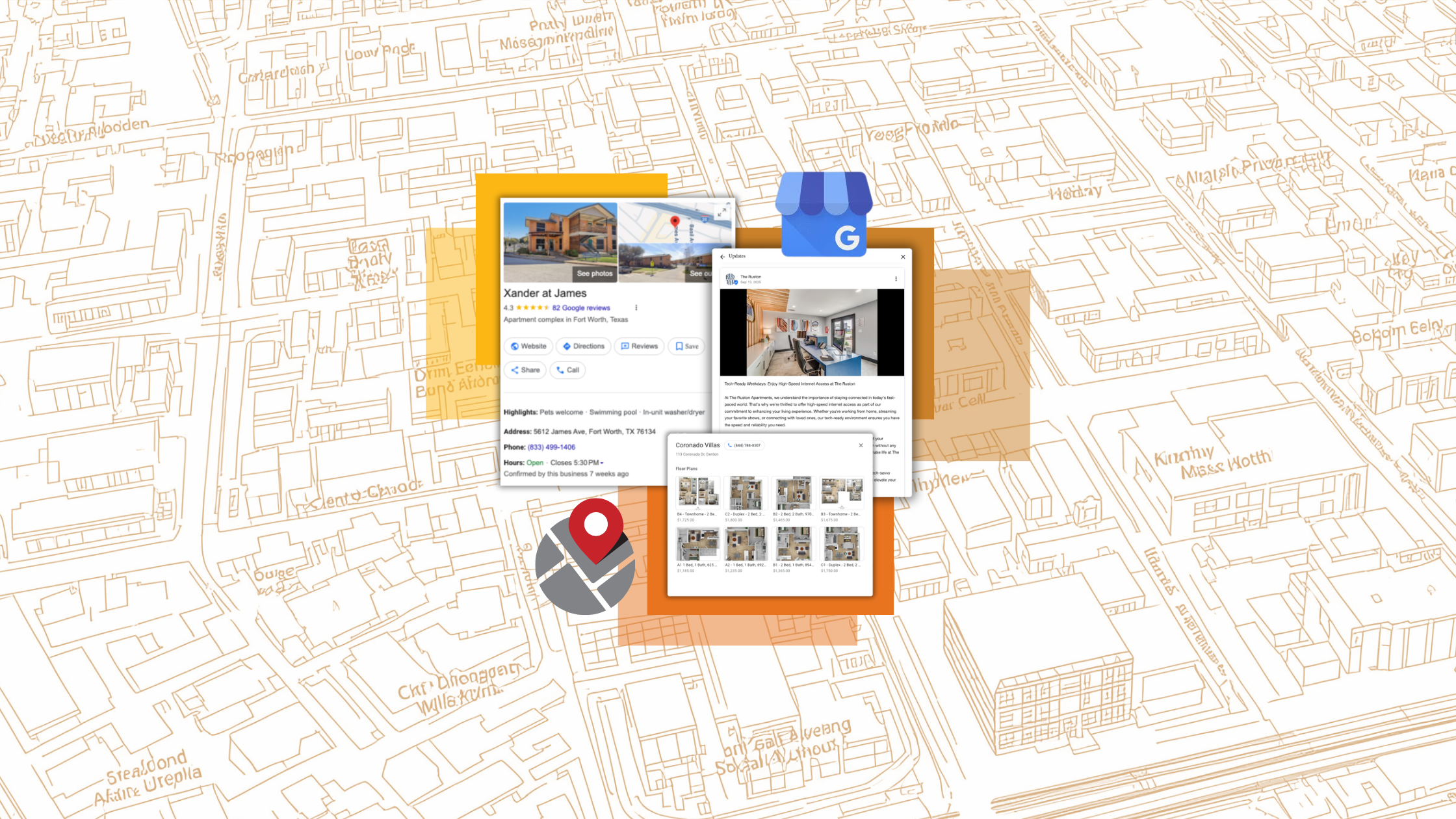


Renters are already asking Google Maps to recommend their next apartment. The question is whether your property shows up when they do.
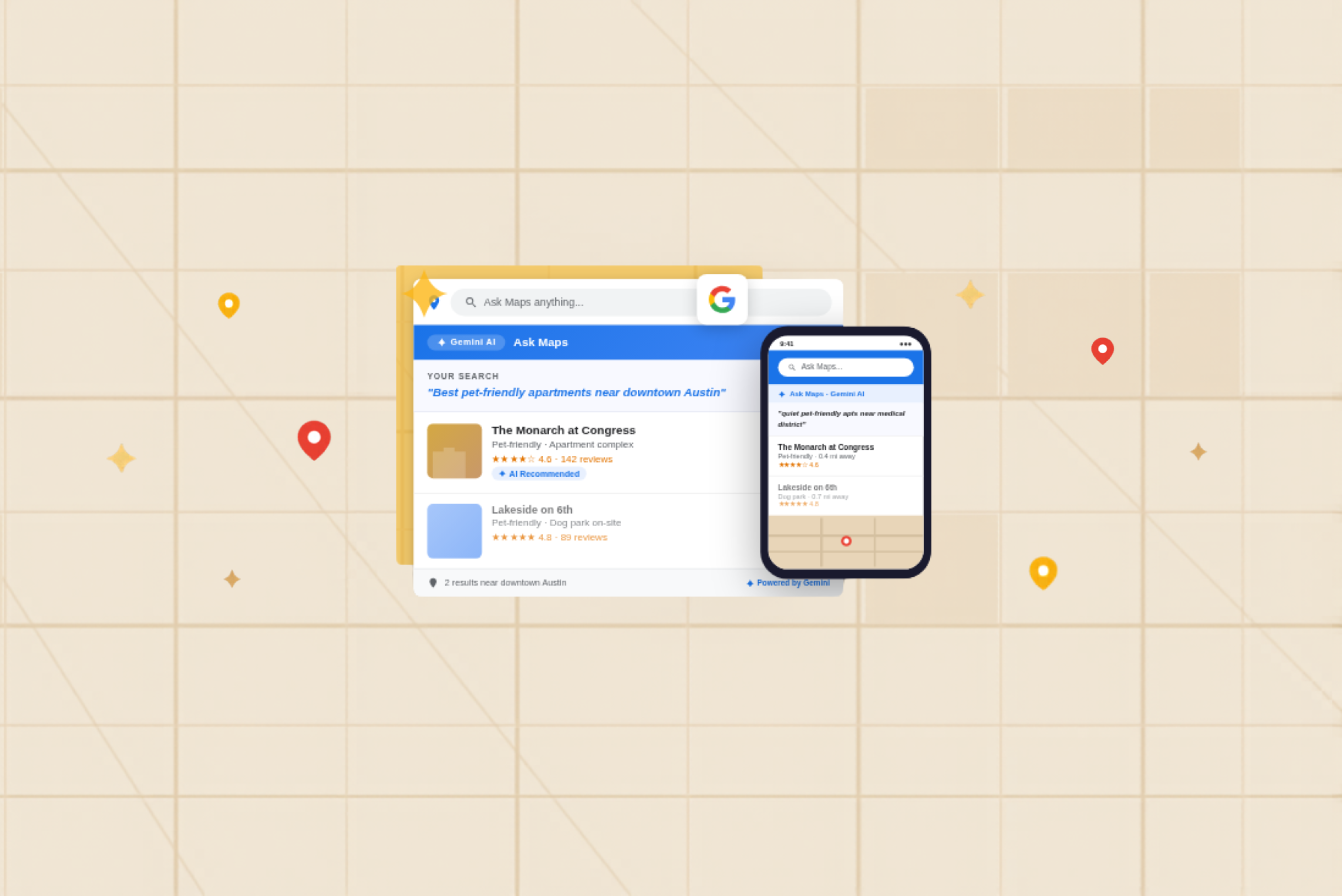
On March 12, 2026, Google rolled out Ask Maps — a conversational AI feature powered by Gemini built directly into Google Maps. Instead of typing a keyword and scrolling through results, renters can now type or talk their way to an answer. “Best pet-friendly apartments near downtown Austin” returns a synthesized recommendation. No list of links. No websites to click through. Just a direct answer.
That’s not a small UI update. That’s a fundamental shift in how renter discovery works.
What Ask Maps Actually Does
Ask Maps lets users ask Google Maps natural-language questions and get back a personalized, AI-generated answer pulled from across Google’s database — 300+ million places and 500+ million contributor reviews.
The feature doesn’t just match keywords. It evaluates what Google is calling attribute match — a new ranking dimension where the AI weighs qualitative signals in a user’s request against the descriptions, reviews, and profile content of every business in its index.
So when a renter asks “quiet apartment community with a pool near the medical district,” Ask Maps isn’t looking for properties that wrote those exact words in a title tag. It’s reading the full signal picture your property sends — your Google Business Profile, your reviews, your structured content — and making a judgment call about whether you’re a match.
That changes everything about what it means to be “optimized.”

Why This Matters More Than Most Google Updates
Ask Maps isn’t arriving in a vacuum. It’s the latest signal in a broader shift that’s been building for years.
ChatGPT now accounts for roughly 12% of Google’s total search volume in the U.S. — that’s 2.5 billion daily prompts. AI-generated answers are replacing traditional results pages across platforms. And according to SOCi’s 2026 Local Visibility Index, 93% of AI Mode search sessions end without a single click — meaning renters are building their shortlist before they ever land on your website.
The discovery moment has moved upstream. By the time a renter visits your website, they may have already decided whether you’re worth contacting. Ask Maps just made that moment happen even earlier — and inside Google Maps, a platform renters already trust and use every day.
Properties that win this moment aren’t spending more on ads. They’re building the kind of profile that AI systems can confidently recommend.

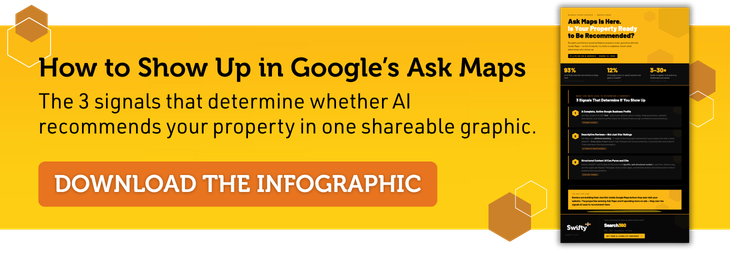
The Three Signals Ask Maps Relies On
According to Google’s own content hierarchy for Ask Maps, it draws from: GBP first, then reviews, then your website, then third-party content. In that order.
That means the AI is looking at your Google Business Profile as its primary source of truth. Here’s what that signals about where to focus:
- Your Google Business Profile Has to Be Complete and Current
If your GBP is missing amenities, has an outdated description, or hasn’t been posted to in months, Ask Maps has weak signal to work with. The AI simply won’t have enough confidence to recommend you.
This means: accurate hours, a description that actually uses the language renters search for, photos that show the experience (not just the exterior), and regular posts that signal an active property. See how GBP optimization is changing for multifamily in 2026 → - Your Reviews Need to Be Descriptive, Not Just Positive
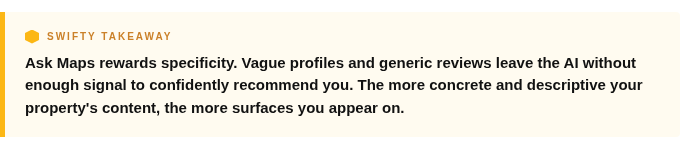
Ask Maps introduced “attribute matching” — the AI reads reviews and the specific language used in them to determine if your property matches a renter’s specific request. A stack of five-star reviews that say “great place, love it!” doesn’t help the AI understand why your property is great or who it’s great for. Reviews that mention specific amenities, community feel, location benefits, and resident experience? Those are the reviews Ask Maps can actually use. That’s what gets you recommended for “quiet community near downtown” or “dog-friendly apartments with a large fenced yard.” Encouraging detailed, descriptive reviews — and responding to them — is no longer just good PR. - Your Structured Content Has to Be Specific Enough to Parse
ChatGPT, Gemini, and Google’s AI Overview all need structured, specific content to pull from when renters ask questions. If your website has generic filler or thin pages with no real answers, AI platforms skip you.
This means FAQ pages that answer real renter questions. Location pages that connect your property to neighborhood context. Amenity descriptions that go beyond a bullet list. Content that reads like a conversation rather than a brochure. Read more on what it takes to be recommended by AI search →
How Swifty’s SEARCH360 Is Built for Exactly This
Ask Maps isn’t a one-off feature to react to. It’s part of a broader transformation in how renter discovery works — one that requires a coordinated approach to visibility across SEO, GEO, and AI Tools simultaneously.
That’s what Search360 is designed for.
Search360 is Swifty’s complete visibility framework for multifamily properties. Rather than optimizing for one platform or one signal, it builds the full stack of what AI systems — including Ask Maps — need to recommend a property with confidence:
- GBP Management — Full optimization and ongoing maintenance of your Google Business Profile, including descriptions, posts, photo cadence, and attribute accuracy
- Smart FAQs — Structured content built around the actual questions renters ask AI tools, designed to be cited by Gemini, ChatGPT, and Google’s AI Overview
- H.E.L.P. Pages — Hyper-Effective Local Pages that connect your property to the neighborhood context AI uses to evaluate attribute match
- Review Strategy — Guidance on driving reviews that are descriptive and specific enough to influence AI recommendations (not just star ratings)
- AI Visibility Monitoring — Tracking how and where your property appears across AI-powered search surfaces, so you’re not flying blind
Unlike an ILS placement that disappears when you stop paying, the visibility SEARCH360 builds compounds over time. The GBP gets stronger. The reviews stack up. The structured content keeps working. You own it.
The Bottom Line
Ask Maps is live, and renters are already using it to build their shortlists. Properties with strong GBP profiles, descriptive review content, and structured local pages will get recommended. Properties without those signals won’t make the cut — regardless of how much they’re spending on Apartments.com or Zillow.
This isn’t about chasing the next Google update. It’s about building the kind of AI-ready presence that earns discovery across every platform — today and the next time Google ships something new.
FAQ: Google Ask Maps and Multifamily Visibility
Does Ask Maps replace traditional Google Maps search for apartments?
Not entirely — traditional Maps search still exists. But Ask Maps introduces a new, higher-intent entry point for renters who know what they want. It’s built for the kind of specific, attribute-based searches renters make when they’re ready to make a decision.
If my property already ranks well in Google Maps, will I automatically appear in Ask Maps?
Not necessarily. Ask Maps uses attribute matching and qualitative signals that go beyond traditional local ranking factors. Strong traditional local SEO helps, but review language, GBP completeness, and structured content are weighted heavily in Ask Maps recommendations.
Do paid ILS listings help with Ask Maps visibility?
No. Ask Maps draws from Google’s own data — your GBP, reviews, and indexed web content. ILS placements don’t influence it. Properties that invest in their own Google presence are better positioned.
How quickly can a property improve its Ask Maps visibility?
A well-optimized GBP can improve AI visibility within weeks. Review content and structured pages compound over months. This is a durable investment — not a quick fix — but the compounding effect means earlier movers have a real advantage.
What’s GEO, and how does it relate to Ask Maps?
GEO stands for Generative Experience Optimization — the practice of optimizing content to be cited and recommended by AI-generated answers. Ask Maps is one of the clearest examples of GEO in action. It’s how you make sure AI tools choose your property when renters ask questions you should be answering.