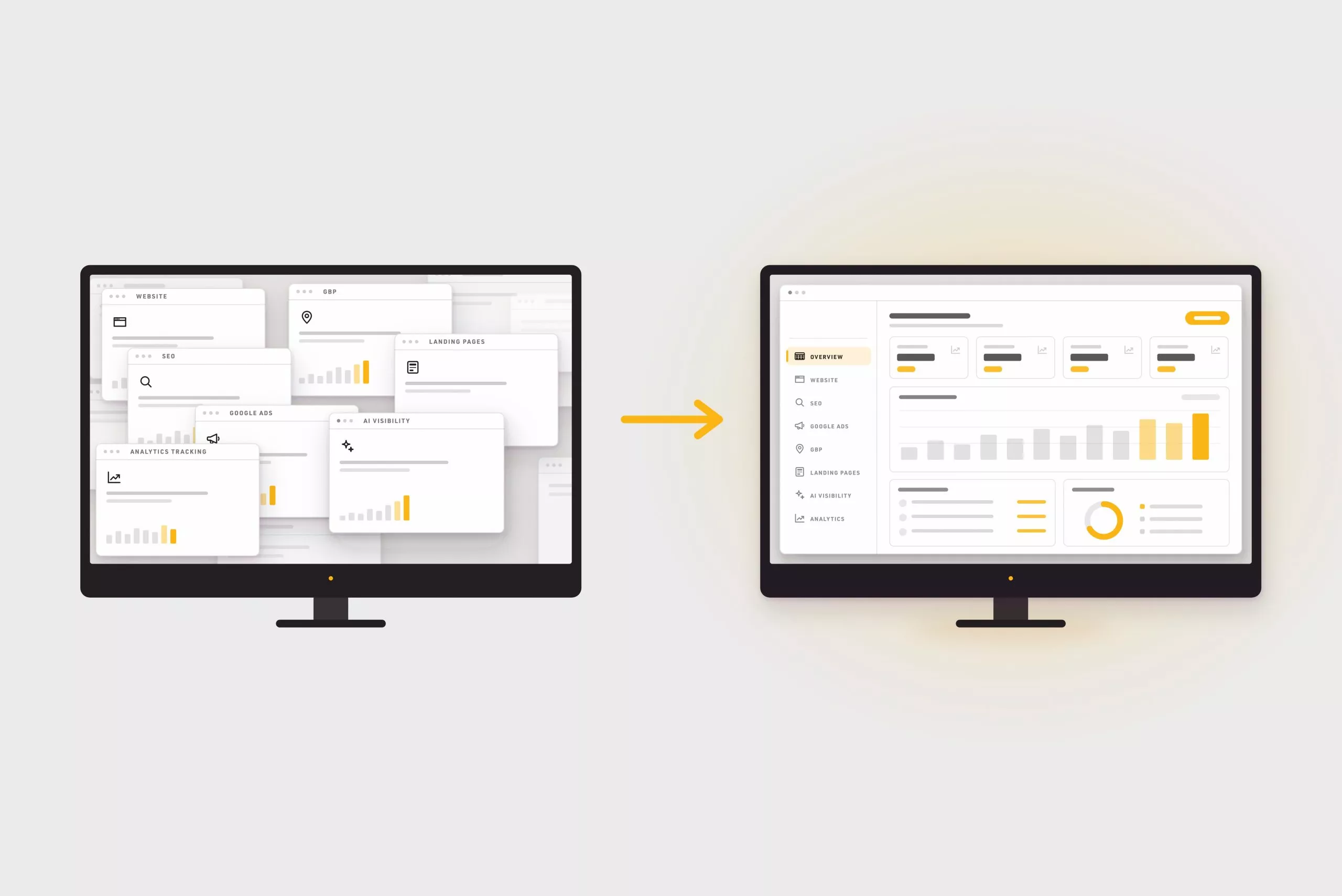


Most apartment marketing is not a system. It is a pile.
A website from one company. SEO from an agency. Google Ads run by a freelancer. The Google Business Profile handled by whoever remembers it. A separate tool for reviews. Each one bills you, each one reports on its own little slice, and none of them have ever spoken to each other.
You are not running a marketing program. You are the integrator holding six vendors together with email threads and hope.
Your Marketing Isn’t Broken. It’s Disconnected.
Here is the problem with a pile. The pieces do not reinforce each other, so you pay for each one separately and still leak leads in the gaps between them.
Your Google Ads send clicks to a website your ads vendor did not build and cannot optimize. Your SEO agency ranks pages your website vendor has to manually update. Your GBP tool posts into a profile that never connects back to the site. Every handoff is a seam, and renters fall through seams.
Worse, nobody owns the outcome. When leases are down, the website vendor blames traffic, the ads vendor blames the site, and the SEO agency says it takes time. You get four reports and zero answers.
An Ecosystem Has a Hierarchy
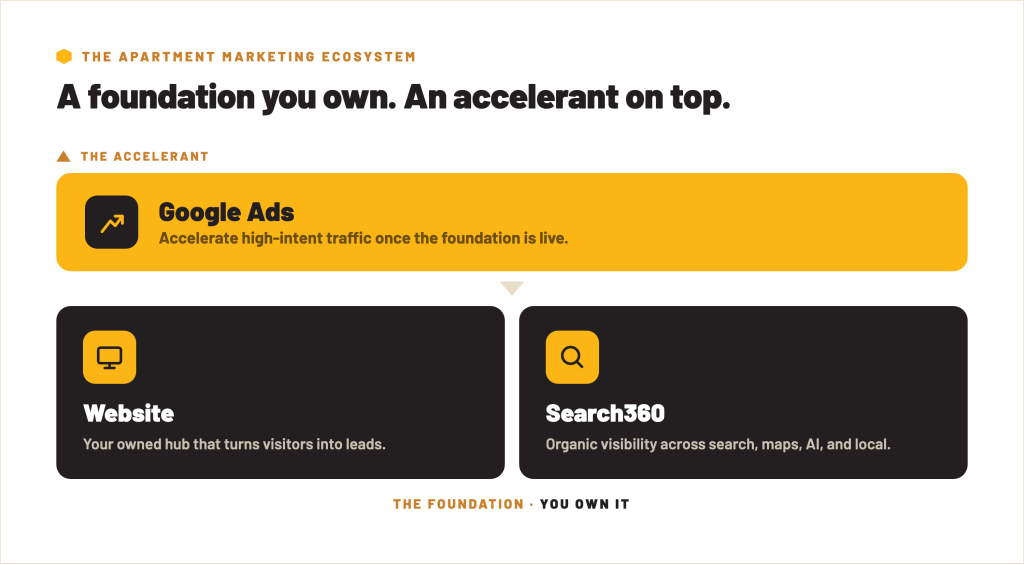
The fix is not more tools. It is an ecosystem: a small set of pieces built to work together, in an order that makes sense. And an ecosystem has a hierarchy. Some pieces are the foundation. One piece is the accelerant that only works once the foundation is there.
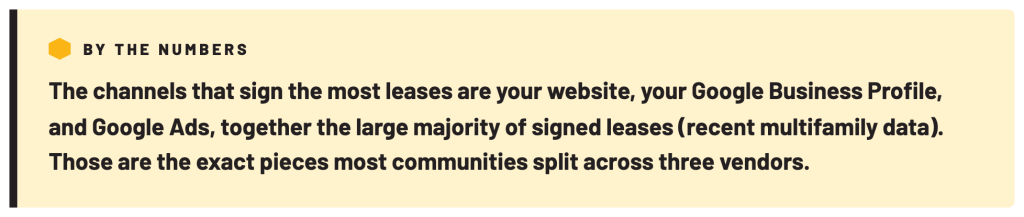
Get that order wrong and you overspend. Pour money into ads before the foundation exists and you are paying to send renters to a house with no floor. Build the foundation first and the same ad dollar goes further, because there is somewhere real for the click to land.
Two layers, in order.
The Foundation: Your Website and Search360
The foundation is the part you own, the part that keeps working whether or not you are spending today.
Your website is the ground floor. It is where every renter ends up, and where the lease is won or lost in the first few seconds. Own it, make it fast and clear, and every other channel has a strong place to send traffic.
Search360 is how renters find that website without paying per click. It is Swifty’s organic visibility engine: H.E.L.P. pages that capture local searches, long-form posts published to your Google Business Profile at least twice a week, and a keyword strategy and Smart FAQs that keep your language consistent across both. It is the traffic you build once and keep.
Together, the website and Search360 are the drive-traffic layer. They are the compounding asset. They do not switch off when the budget does.
The Accelerant: Google Ads on Top
Google Ads is not the foundation. It is the accelerant you add once the foundation is in place.
Paid search buys you immediate visibility for the highest-intent searches. But a paid click is only as good as where it lands, and it stops the moment you stop paying. Run on top of a strong owned foundation, it pours fuel on a fire that is already lit. Run on its own, it is just an expensive faucet.
That is the whole point of the hierarchy: the foundation makes the accelerant work. Owned and paid are not competing line items. They are two layers of one system.

Why One Vendor Beats Six
When the pieces come from one vendor, built to connect, the seams disappear.
- The click lands where it should. Ads point at pages built to convert, because the same team builds the site and runs the ads.
- The data is one story. One dashboard, one login, one view of what is actually driving calls and leases, instead of four reports that do not reconcile.
- The pieces reinforce each other. Your Google Business Profile posts link back to your website. Your organic pages and paid campaigns share a keyword strategy. Nothing is stapled on.
- Someone owns the outcome. When one vendor runs the whole system, there is no one to point at. The number that matters is cost per lease, and it is their job to move it.
There is a reason this matters. Google now reports how often a site’s pages appear in AI answers, and in our experience, communities running a connected system tend to have more of their pages cited. Not because the homepage did more, but because more of the site was built to work together. That kind of reach is not something any single tool bolts on. This is not about buying more. It is about buying a system instead of a stack, so the pieces finally pull in the same direction.

How Swifty Handles This
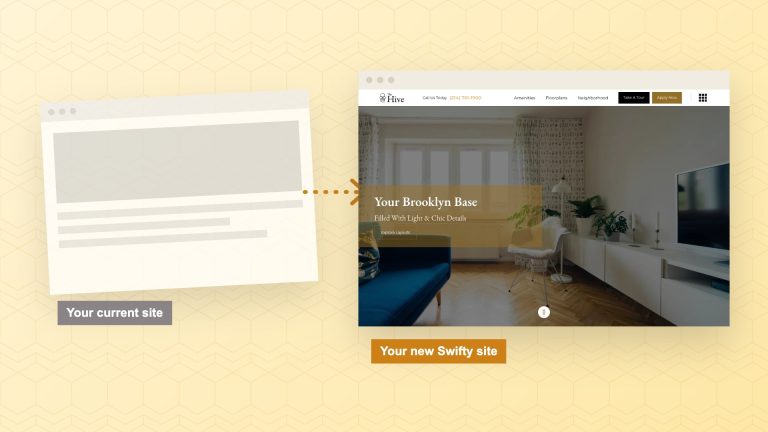
Swifty is built as the ecosystem, not another piece to add to your pile. The foundation and the accelerant, from one vendor, built to work together:
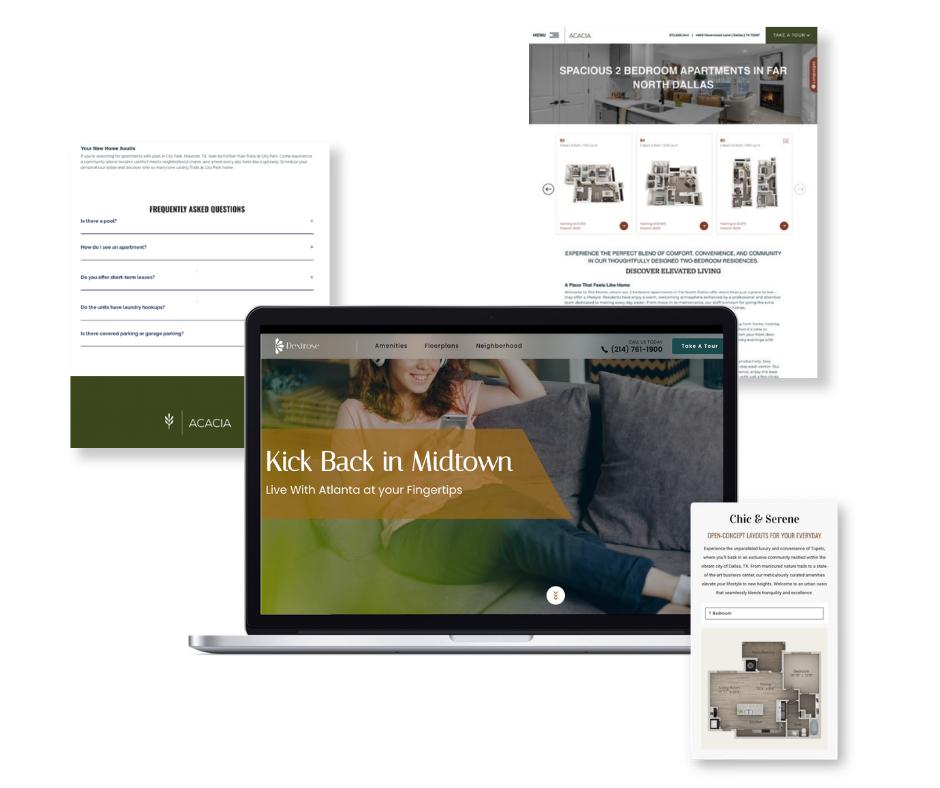
- Website. A fast, clear, mobile-first site you own, built to convert the traffic everything else sends it.
- Search360. H.E.L.P. pages, long-form Google Business Profile posts, keyword strategy, and Smart FAQs, driving organic traffic to that site.
- Google Ads. The paid accelerant, layered on once the foundation is live, pointing every click at a page built to convert.
- One login, one team, one number. All of it in one platform, measured against cost per lease, with one team that owns the result.
The pieces are the same ones you are probably already paying for. The difference is they finally talk to each other.

The Bottom Line
You do not fill units by buying more tools. You fill them by connecting the few that matter. Build the foundation first, a website and Search360 you own, add Google Ads as the accelerant on top, and run it as one system instead of six invoices. The communities that treat marketing as an ecosystem, not a pile, are the ones that stop leaking leads in the gaps.
FAQ
What are the core pieces of an apartment marketing ecosystem?
Two foundation pieces you own, your website and Search360 (organic visibility), plus one accelerant on top, Google Ads. The foundation drives and keeps traffic; the paid layer speeds it up once the foundation is live.
Why not just use the best vendor for each piece?
Because the pieces have to work together, and separate vendors optimize their own slice, not your leases. The seams between them are where renters and dollars leak. A connected system beats four best-in-class silos that never talk.
Do I have to replace everything at once?
No. Most communities start with the foundation, the website and Search360, then layer Google Ads on top. The point is to move toward one connected system, not to rip everything out overnight.
Isn’t one vendor riskier than spreading it out?
Spreading it out feels safer and usually performs worse, because no one owns the outcome. One vendor running the full system means one number to hold them to: cost per lease.
Related Blog Posts

The Buzz
Get Our Best Marketing Tips
New articles on multifamily marketing, search, and AI, straight to your inbox.